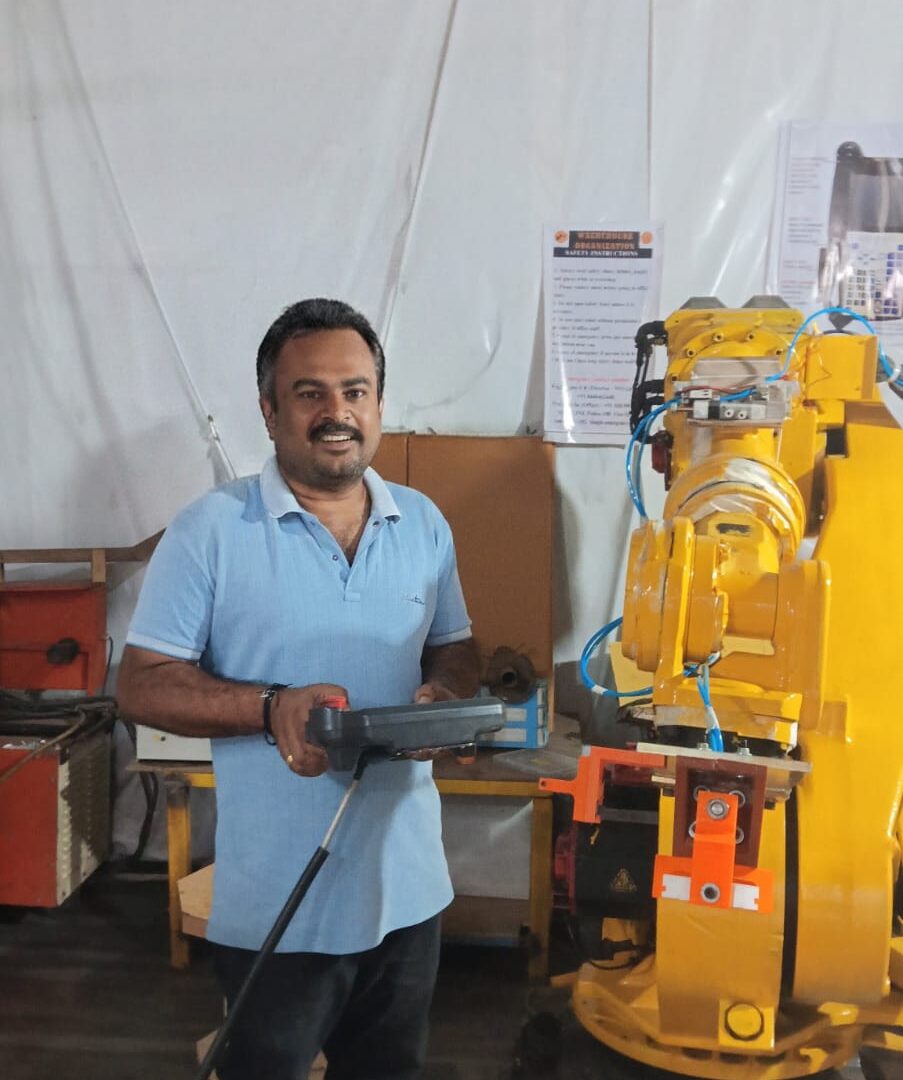
Photographs of robotics training tend to show the robot. We would rather show the pendant. The unit in a trainer’s hand — with its emergency stop and jog controls — is where the real learning happens, long before a learner is trusted to run a program unsupervised.
Why the pendant comes first
Anyone can watch an industrial arm move. Understanding how to jog it safely to a target position, teach a point, set a speed override and recover from a fault is a different skill entirely, and it is the one that actually gets someone hired on a shop floor. Our training sessions spend real time here before a learner ever writes a full program.
A fixture built for the whole cycle
The workstation in our lab is deliberately labelled in plain steps: Job Picked, Inspection, Tool Change. That sequence mirrors what an operator sees on a real production cell — a part is presented, inspected against a standard, and either passed on or flagged. Training on a rig that mimics an actual work cycle, rather than an isolated demo move, is what makes the certification mean something to an employer.
Who this is for
- Engineering students building a portfolio beyond classroom theory.
- Working technicians upskilling into robotics and automation roles.
- Manufacturers sending shop-floor staff for certified, hands-on training rather than a vendor demo.
The point of hands-on training
A learner who has only watched a robot move will freeze the first time a real cell throws an unexpected fault. A learner who has jogged the arm, taught points under supervision and recovered from a stoppage on this exact kind of fixture generally will not. That difference is the entire reason the training floor exists.